

There is no single right age for a hair transplant. What matters more is how settled your hair loss is, how much donor hair you have, and whether your goals are realistic. Surgeons tend to be cautious with younger men and to focus on donor supply and health with older ones.
Below, we look at what changes with age and what a surgeon weighs up at each stage. We also cover how to judge whether now is your moment.
Is there a minimum or maximum age for a hair transplant?
Not in any simple sense. A surgeon assesses the person in front of them, not a number on a form. Two men of the same age can have very different hair, health and expectations.
Age still plays a part, but as one piece of a bigger picture. It shapes how predictable your hair loss is and how much donor hair you can spare. It also affects how the result needs to look decades from now.
So the honest answer to both questions is usually the same. It depends on your hair, and an assessment will tell you more than your birthday can.
Why are surgeons cautious with younger patients?
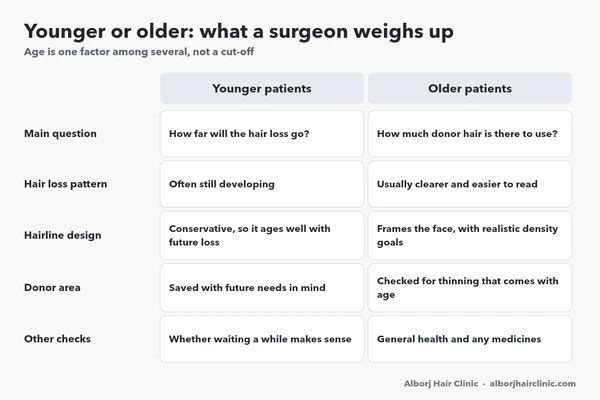
The main worry is that early hair loss has not shown its full pattern yet. A man whose hairline has only just started to move may keep thinning for years. Nobody can say exactly how far it will go.
That creates a planning problem. A low, youthful hairline filled in now could end up stranded if the hair behind it thins later. Donor hair is limited, so using too much early can leave less for the future.
A careful surgeon may respond in several ways:
- Wait and watch. Tracking the loss for a while shows how fast it is moving and where.
- Plan conservatively. A slightly more mature hairline tends to age better than a very low one.
- Think long term. The design should still look natural if the surrounding hair keeps thinning.
- Look at other routes first. A doctor may suggest other options before surgery.
None of this rules younger men out. It simply means the plan has to allow for hair loss that has not happened yet.
What matters more for older patients?
Later in life, the pattern of loss is usually clearer, which can make planning easier. The questions shift towards supply, health and expectations.
- Donor supply. Hair at the back and sides can also thin over time. The surgeon checks how many healthy follicles can be moved without leaving that area looking sparse.
- General health. Even under local anaesthesia, a transplant is still a procedure. Expect questions about any health conditions and the medicines you take.
- Realistic goals. With extensive loss, the aim is often to frame the face and add density where it shows most, rather than rebuild a teenage hairline.
Hair colour, thickness and texture also affect how full a result can look, whatever your age. A surgeon will talk this through honestly at the consultation.
“I would rather tell a young man to wait than design a hairline he will not want in fifteen years. With older patients, the question is usually what the donor area can support. At any age, the original hair around the grafts can keep thinning, so the plan has to allow for that.”
What actually decides whether you are a good candidate?
Age sits alongside several more telling factors. At a consultation, a surgeon will usually consider:
- The stage of your hair loss. Men are assessed on the Norwood scale. Women are assessed on the Ludwig scale, which has three grades.
- How stable it seems. Loss that has slowed down is easier to plan around than loss that is moving quickly.
- Donor density. The amount of healthy hair at the back and sides sets the limit on what can be moved.
- The cause. Sudden, patchy or evenly spread shedding usually needs a medical cause ruled out first.
- Your expectations. A sound plan matches what your donor hair can realistically achieve.
Patience is part of suitability too. Transplanted hairs often shed in the early weeks, and fresh growth tends to appear at around three months. The final look takes about a year.
How do you know if now is the right time?
A few honest questions can help before you book an assessment:
- Has my hair loss changed quickly over the past year or two, or has it slowed?
- Would I be happy with a hairline that suits me in later life, not only today?
- Can I wait around 12 months to see the full result?
- Am I ready for the hair around the transplant to keep changing as I age?
If the answers feel uncertain, that is useful information in itself. An experienced surgeon can tell you whether to go ahead, adjust the plan or wait a while.
In the meantime, grooming can do a lot. A shorter cut, a textured style or a well-shaped beard can all change how thinning hair reads at a glance.
About Alborj Hair Clinic
Alborj Hair Clinic is a hair transplant clinic in Mazaya Centre, Al Wasl, Dubai. Its surgeon, Dr Dimitrios Ziakas, has 24 years of experience and has performed more than 4,000 hair transplant procedures. He is a member of the International Society of Hair Restoration Surgery (ISHRS) and uses the DHI (Direct Hair Implantation) technique.
Readers weighing up their options can browse before-and-after case studies on the clinic’s website.
Frequently asked questions
Should I wait if I am young and only slightly thinning?
Often, yes. Watching how your hair changes for a while gives a surgeon a clearer picture, and a consultation can tell you whether waiting makes sense.
Is there an age when it is too late?
Not as such. What counts is whether you have enough healthy donor hair and are in good general health for a procedure.
Will transplanted hair fall out as I get older?
Once established, transplanted follicles normally keep growing for life. The original hair nearby can still thin, which is why surgeons plan ahead for it.
Does age matter for women considering a transplant?
Much as for men, suitability depends on the pattern and cause of thinning and on donor hair, not on age alone. A surgeon will grade the loss on the Ludwig scale.
